|
page two |
|
page two |
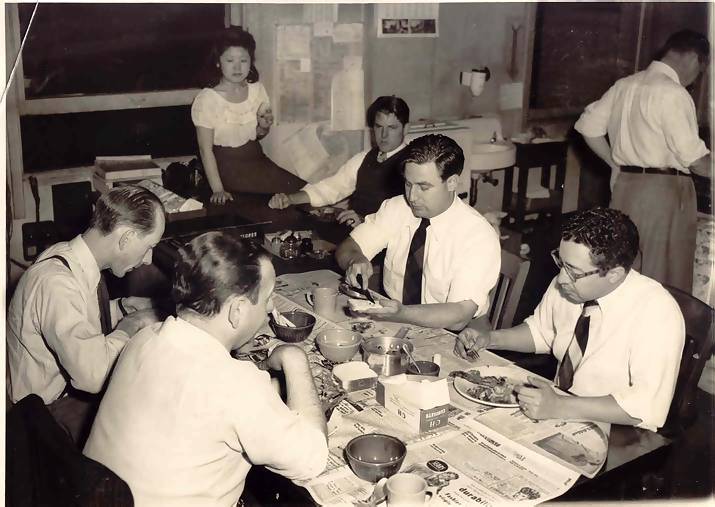 WEEKS BUTTERS UP STAFF: DN reporter Paul Weeks (center, black tie), butters toast while presiding over weekly steak-fry up held in the city room. Librarian Mary Kitano, hired directly from the Manzanar Relocation Camp, observes. L to R: rewrite man John Clark, city editor Aaron Dudley (foreground), Kitano, Archie Lee, Weeks, night city editor Joseph "Sparky" Saldana. (Collection of Paul Weeks.) Click pic for larger view. __________________________________________________________________
|
EX-'NEWSIE' WEEKS
TOURS OLD CITY ROOM (continued from page 1) Getting up to the third floor was like trying to get up Bunker Hill without Angels Flight. The elevator, unfaithful as it always was, had disappeared. It was the elevator that carried a sign saying it was good for umpty-ump thousand successful trips. Someone in our party remembered that a jokester had once scribbled a series of 1111's on it, with a (/) slash through each to make it five. It didn't score through the first umpty. Were the ghosts parading - the string of city editors: Frank Rogers, Jim Felton, Milt Phinney, Jerry Luboviski, Chuck Chappell, Aaron Dudley -- in my eight years alone? Where John Clark once sat on rewrite, a seamstress -- like Madame de Farge -- was stitching a chronicle of the misdeeds of today where John once stitched the misdemeanors of the likes of Senator Joseph McCarthy and the House UnAmerican Activities Committee. Another, unperturbed as the magnificent Jack Smith, sewed smooth seams as even as his copy at the spot in the middle of rewrite. I inherited his desk, but not his shoes, when Jack moved on to pastures with more greenbacks. Was the sewing of the steady, serious lady matching the brilliance of Sarah Boynoff? And look over there - the window where Jan Haas got her light for her photo retouching - wasn't that next to the one where Don Dwiggins threatened to throw his typewriter to the pavement below? That was also the row where anyone who prepared the day's national weather map also had to include - was it Jamestown or Valley City, North Dakota? - as photog Don Hoster's patriotic tribute to his old hometown. None of us came back striding like MacArthur ("I shall return!") - Jack Jones for one. Back at Genio's both Goldie Norton and Don Alpert had claimed to have been Jack's replacement when he moved up from copy boy to reporter. Jack, did it take two of them? All three of them went on to successful careers. Helen Brush (now Jenkins) had her cameras with her, but she doesn't tote a clumsy Speed Graphic along today as she did when she popped flashbulbs in the face of Madam Brenda Allen, who operated her Hillside House of Joy (Jack Smith's label). Roy and Vivian Ringer completed our Last Roundup, with spurs still jingling. Aaron Dudley and John Beckler's absence was particularly painful. Both had left us within the past year. Sweet Dud, always gentle and cool on the city desk. Beckler, a model for every seeker of an ethical career in journalism . . .John moved to The Times, then to the AP's staff in the nation's capital, when he got bored rewriting handouts at the LAT. Matt Weinstock - now there's a man who symbolized everything that was good about the Daily News, his columns insightful, piquant, funny and down to man-on-the-street delight. We ought to elect him posthumously to OFS membership. The seamstresses today seemed to have no Ortega y Gossett editorial policy like the old Daily News. Publisher Manchester Boddy's liberality was jolted occasionally, as when he challenged Helen Douglas for the Democratic Senatorial nomination, surprisingly tinting her campaign with red - and Richard Nixon won the seat. ("Boddy's a guy who leads liberals up dark alleys and stabs them," Verne Partlow used to say. Partlow, who composed our anthem, "A Newspaperman Meets Such Interesting People," as well as "The Atom Bomb Song" in the midst of the Senator McCarthy rantings. He didn't get to go down with the ship with us. He was fired, but not for his music or his capable reporting. They put a "red" label on him, too.) Les Claypool walked the tight rope of political reporting with straight, no-nonsense copy. He would have been on Nixon's hit list along with our Ed Guthman and Dick Bergholz. It is frustrating not to have the space - nor your patience, I appreciate - to call the role from the likes of Pearl the Mail Girl, rotund photog Cliff Wesselman, Gordon Macker, on and on. Mr. Boddy, you had the liveliest crew that ever tramped the grapes of your vineyards. Even if we got no severance pay, we got much more than stained feet. No wine was ever so intoxicating. MR. WEEKS PASSED AWAY JULY 10, 2007 AT 86. SEE HIS Q&A for more reminiscences, and obituary.
|
copyright 2003, 2021 Rip Rense, The Rip Post, all rights reserved.